


More About Reading Logs
 It occurs to me that I never did tell you why Natalie Babbit agrees with me about reading logs. (You do know who Natalie Babbit is, don’t you? She wrote Tuck Everlasting. Go read it. Now.)
She wrote, not specifically about reading logs, but about the panic all around her (in 1986) that literacy skills were devolving. This is from her speech “Easy Does It.”
We are blaming our children’s poor reading and writing skills on television, an easy and pleasant machine, and also on the seductive and mysterious computer, which, I understand, is easy and pleasant too….There can be no question about the fact that these two inventions are changing our world. They are only the latest things to change our world, which has been in a constant process of change since its creation…. Still, I think it’s highly debatable that they are single-handedly responsible for our difficulties….It seems to me that it’s not so much the difficulties that are new as it is our expectations.
When I was a child in the good old days, my friends weren’t all word lovers, not all book lovers, not all good readers and writers….And all were growing up without television and computers. It seems to me as if we simply can’t expect a universally high level of enthusiasm about reading. That expectation seems new to me. And, unfulfilled, it carries with it for our teachers [and, I’d add, our kids] a heavy and inevitable load of blame. But there always was and always will be a percentage of children that finds reading stale, flat, and unprofitable….
And if we–you and I–go on believing that we can, should, and must graduate all children from high school and college into a lifetime of appreciative reading of literature, and a capacity for clear and graceful writing, we will, quite simply, break our hearts….
The only thing we can do, I guess, is fight fire with fire….Somehow [teachers] are going to have to find a way to make reading as seductive as its rivals–to make it, in other words, easy and pleasant. Because that, it seems to me, is the only thing that was better about the good old days. Books–for me, anyway–were easy and pleasant.
One of the things that makes books easy and pleasant was the practice of reading aloud. Almost any writing is easy and pleasant when it’s read aloud. My fifth-grade teacher, Mrs. Wilson, read aloud to us every day for the last half hour, and she read aloud for pleasure, hers as well as ours. We weren’t tested on the books she read to us. We didn’t do projects or write to authors. We just relaxed and enjoyed it….
Some of the things I hear about that are being done with books in classrooms now make my blood run cold….Books have collected countless barnacles of peripheral stuff these days, and how can that do anything but turn reading into hard work?…
Use a little low cunning. Ease up on the projects, schedule time for reading aloud. Read aloud things that you really like, yourself. Everyone responds to a good story, and that is what good literature really is: a good story, well told.
I think we can go a long way if we take that route. Honey, you know, is actually good for us nutritionally. So is peanut butter. But they taste so good that we forget about the nutrition. Reading is like that. Or at least it should be. And could be. Maybe. All we can do is try.
This marvelous essay and many more are found in Barking With the Big Dogs: On Writing and Reading Books for Children.
Read More
New England Vampires

JB exhumed skeleton beings studied at the National Museum of Health and Medicine.
Forensic science and folklore can piece together some truths about life (and the afterlife) in New England in the 1700s and 1800s. Like Mercy Brown in Mercy: The Last New England Vampire, JB was a real person, a Connecticut farmer who died of tuberculosis….and whose community dug up his grave after his death, convinced he was a vampire. The Washington Post details new discoveries about him here…one of the few so-called vampire burials to be exhumed and studied.
You don’t have to travel to Transylvania to encounter homegrown vampire folklore. The same legends that led to JB’s exhumation were the basis for my YA novel Mercy. Family, loss, terror, and love–the elements of a good horror story or a supernatural legend.
Read More
Chicken Rescue

I am a DINOSAUR!
Normally I post about writing or books…but it’s summer and things are slow so I thought I’d treat you all to a chicken story.
Yesterday I was driving my daughter home from her grandmother’s house when she called out from the back seat.
“Chickens!”
“What?”
“Chickens! Over there! The chickens are out!”
About three blocks away from her grandparents’ house, five chickens live in a backyard coop. When she was four or five, it was an adventurous walk to go down and visit them and poke bits of grass through the wire for them to peck at. When she learned to ride a bike, she could zip down to check on the chickens and see how they were faring.
And now they were loose! Emergency!
I pulled over and we hurried back half a block to check. Sure enough, the two white chickens with red crowns were pecking happily outside the pen. The single brown one and two black-and-white speckled ones, apparently more peaceful, were still inside the coop.
My daughter went up to knock on the back door to let the owners know their chickens were out. No answer.
Okay. Chicken rescue was underway!
I thought I could just pick them up and toss them gently back into the pen. I edged toward one. It eyed me and edged away.
Now, I have just been listening to a podcast all about dinosaurs. And it was heavy on the “birds are really dinosaurs” thing. And this chicken was really giving me a very nasty glare. The closer I got, the more vicious its claws looked. Velociraptor vicious. Seriously. I inched a tiny bit near and it sprinted away on bright yellow legs that looked very muscular indeed.
No way was I going to be able to pick this tiny little T. rex up.
It led me on a chicken-chase around the coop twice before I had the bright idea of telling my girl to stand by the coop entrance. I shuffled behind the two chickens and waved my arms. She blocked them when they tried to dart to one side, and between us we whooshed them into the coop and shut the door smartly. The three in-coop chickens did not make a break for it. Success!
It’s not often that my work days are interrupted by chicken rescue. Very exhilarating, really.
We drove away quickly just in case they found whatever hole in the fence let them escape in the first place. It would just be too stressful to go through the whole thing again.
Read MoreAmazing News for Amazing Tigers!

There is actually a tiger in this picture–they are way more camouflaged than you would think. This is one of India’s tigers, a (nearly grown) cub my daughter and I saw in Ranthambore National Park!
It can be hard to find good news out there when it comes to environmental issues. So I’m delighted to share that India has managed to double its tiger population from 1,411 in 2006 to to 2,967 today.
When I read Amazing Tigers in elementary schools and share with kids the horrifying decline in tiger populations in the last century, they are always shocked and eager to set to work to make the world safe for tigers. Glad I’ll have some good news to share the next time I visit a school.
Read MoreTwo Summery Haiku
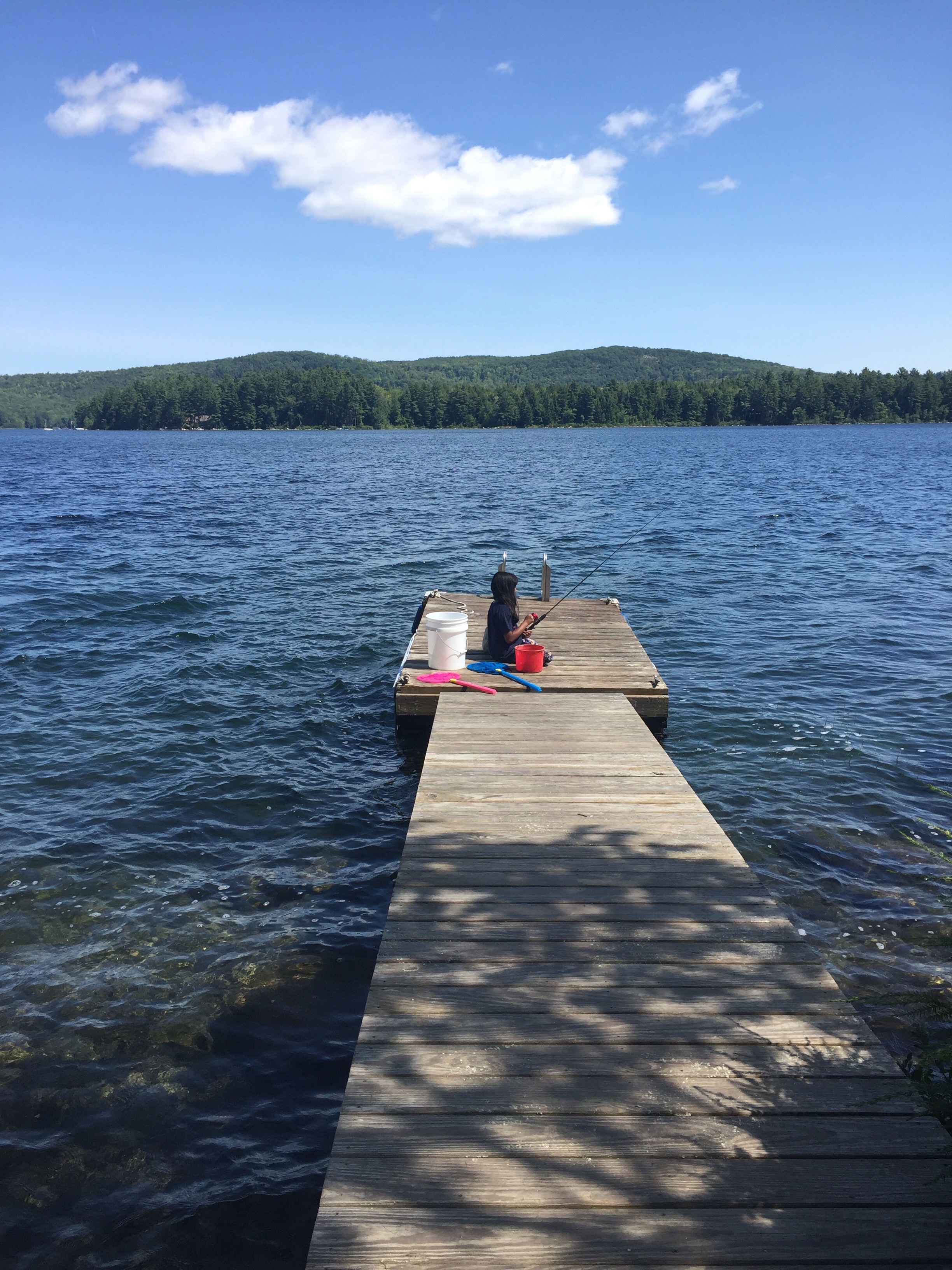 At last it’s summer in Maine (we’ve been waiting so long!)! So here are two poetic expressions of the season.
On the Dock #1
Weight of sunlight
on my skin–golden sawdust
sifting down.
On the Dock #2
Shock of deep green cold
slaps through me swallows me
diving in.
Highlights Stands Up for ALL Kids
 Proud to have three of my books published by these fine folks! The CEO of Highlights Magazine says, “Our company’s core belief…is that ‘Children are the world’s most important people.’ This includes ALL children.”
Why I Hate Reading Logs (and Natalie Babbitt Agrees with Me)
I have a fifth grader–okay, I used to. She graduated a few weeks ago. That means I’ve been a witness to six years of the current educational practices of northern New England. Specifically, six years of reading logs.
I do not like reading logs.
For the first few years, I just had to fill them out myself, which was not such a big deal. But then she hit third grade, and the rules started to rain down upon us.
She had to fill the logs out herself. She had to write the author’s last name, then first name. Then the full title of the book, even if it was (and it often was) Geronimo Stilton and the Mystifying Midadventure of Mumbling Mansion (with Cheese). She had to write the pages she started on, the page she stopped on, and the number of minutes read.
And there were so many ways to get it wrong. Reading more than two books at once was wrong. Reading a book and stopping halfway through was wrong. Skipping around in a book was wrong. Reading ten minutes Monday and an hour Tuesday was wrong, although reading twenty minutes on Monday and twenty on Tuesday was right.
It drove me nuts. I objected. Frankly, I should have told her teachers we were not filling in the silly logs, but my girl is a rule-follower and doesn’t tolerate civil disobedience well, and the very idea panicked her. (I was a teacher’s pet myself for many years, so I understood what she was feeling.) Doing the logs was anxiety producing, and having your mom call to say you would not be doing them anymore was even worse.
How could it be possible that all of this actually helped anyone develop a love of reading?
Now for a change of subject (bear with me, it’s related):
I’ve been thoroughly enjoying Barking With the Big Dogs, a collection of Natalie Babbit’s speeches and essays. It’s marvelous. She raised her children and did most of her writing before the advent of reading logs, but she had quite a bit to say about the way reading and the love of books are taught. So more on this next week….
Read MoreSarah L. Thomson
A children’s book author publishing award-winning nonfiction, poetry, picture books and novels including…

“Thomson focuses on newfound connection, magic, and suspense to conjure a fast-paced, heartwarming mystery. Thomson’s world is populated by resourceful protagonists, fanciful creatures, and quirky supporting characters.”
—Publishers Weekly